

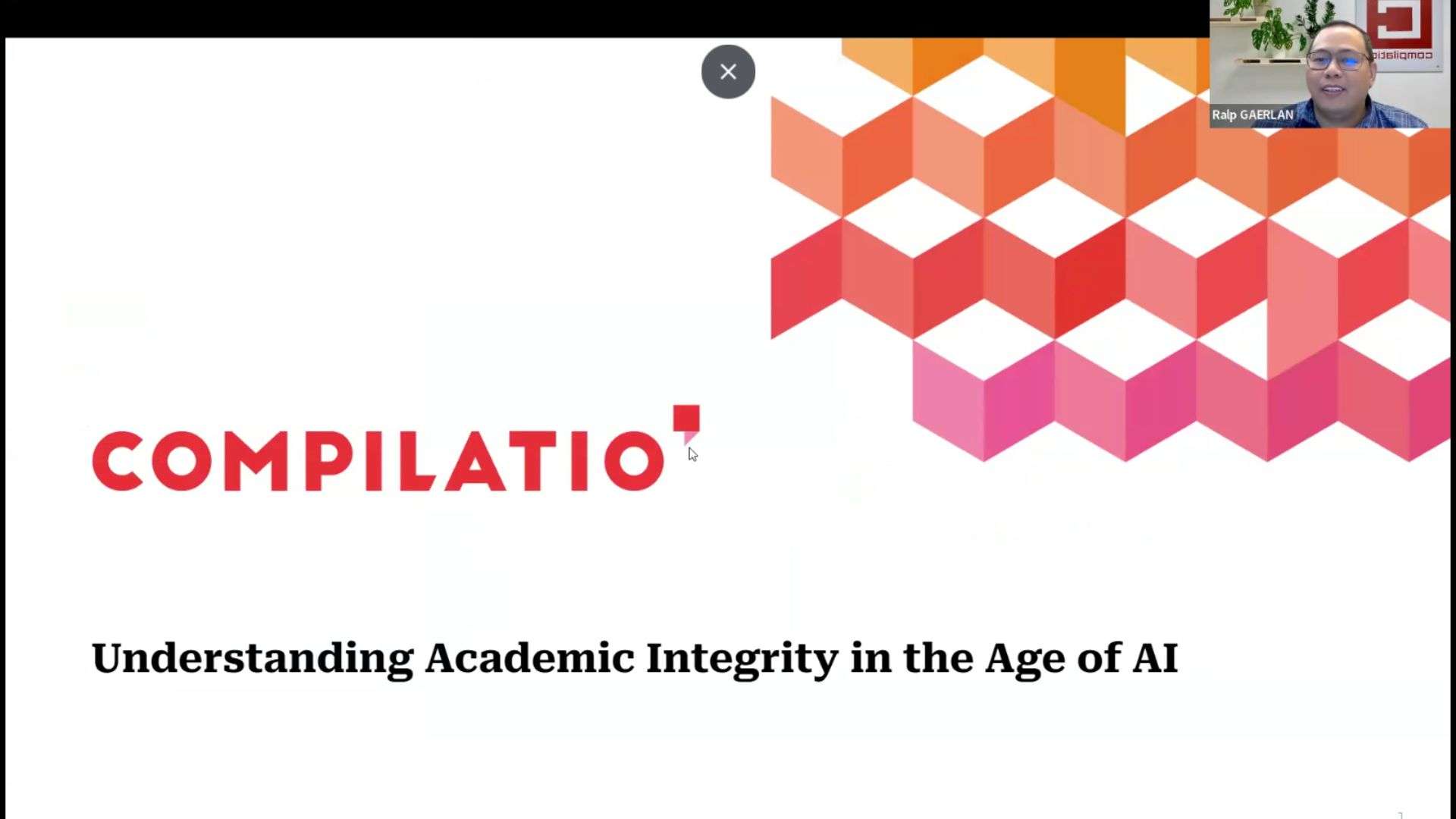
Pukunui Continues 2026 Webinar Series with Compilatio on AI and Academic Integrity
Concerns surrounding Generative AI in education are understandable, but they are not entirely new. Similar anxieties emerged with the introduction of calculators and later the internet. Today, AI represents the latest technological shift, challenging traditional teaching and assessment methods.
In the second session of Pukunui’s 2026 webinar series held in February, Ralph from Compilatio, a trusted partner of Pukunui, shared how institutions are beginning to move beyond fear and towards practical, structured responses.
Compilatio specialises in academic integrity solutions, offering tools for plagiarism detection and AI-generated content analysis that integrate seamlessly with platforms such as Moodle. The session emphasised that the role of technology is not merely to detect misconduct, but to support educators in fostering ethical and responsible use of AI in learning environments.
Key Takeaways from the Session
Academic Misconduct Has Evolved
Traditional plagiarism has developed into more sophisticated practices. Students now use AI for paraphrasing, generating fabricated citations, and outsourcing cognitive tasks such as analysis.
Detection Tools Are Indicators, Not Verdicts
AI detection should be treated as a signalling mechanism rather than definitive proof. The final judgement must always involve human evaluation.
The “Metal Detector” Approach
Tools such as Magister+ function like a screening layer. They identify patterns such as syntactic similarities and hidden text manipulation, which may require further investigation by educators.
Integration with Moodle Enhances Workflow
Embedding detection tools within Moodle allows educators to review reports directly within assignments, streamlining the assessment process and ensuring consistency across courses.
Educators Remain Central
Technology supports decision-making, but it does not replace the educator’s understanding of a student’s writing style, behaviour, and academic progress.
Watch the Recording
Snippets from the Recording
Understanding New Forms of Academic Misconduct [05:30]
The session explains how students are increasingly using AI for paraphrasing, generating fabricated references, and outsourcing critical thinking tasks, making misconduct more difficult to detect using traditional methods.
AI Detection as a Support Tool, Not a Verdict [12:45]
Ralph introduces the “metal detector” approach, emphasising that AI detection tools should serve as indicators for further review rather than definitive proof of wrongdoing.
How Magister+ Identifies Hidden Manipulation [18:20]
A walkthrough of how Magister+ detects syntactic similarities and hidden text techniques, such as invisible characters that are often missed by conventional systems.
Seamless Integration Within Moodle [25:10]
Demonstration of how Compilatio integrates with Moodle, allowing educators to review reports directly within assignment workflows.
Role of Educators in the Age of AI [32:00]
The session concludes by reinforcing that technology supports, but does not replace, the educator’s role in interpreting results and guiding students towards ethical academic practices.
Q&A Highlights
Is AI detection completely accurate?
No. No detection tool offers complete accuracy. Results should be used as a starting point for discussion rather than definitive proof of misconduct.
Does Grammarly trigger AI detection?
It can. Since Grammarly uses AI for writing suggestions, it may be flagged. Educators need to distinguish between AI-assisted editing and fully AI-generated content.
Can Compilatio be integrated into Moodle?
Yes. Compilatio integrates with Moodle, allowing automatic analysis of submissions within activities such as Assignments.
Do students have access to the reports?
This depends on institutional settings. Reports can be made visible to students or restricted to educators.
Will this affect grading performance or speed?
No. The analysis runs in the background and does not interrupt the grading workflow.
How is data privacy managed?
Compilatio complies with GDPR standards, ensuring secure processing of data and allowing institutions to manage document storage and deletion.
Pukunui would like to thank Ralph from Compilatio for his time and for sharing valuable insights on navigating AI and academic integrity in today’s learning environment. We would also like to thank all participants for joining the session and contributing to the discussion.
As highlighted throughout the webinar, maintaining academic integrity in the age of AI is not solely about detecting misconduct. It is about guiding students towards ethical, responsible, and meaningful use of technology in their learning journey.
Please join us again for our upcoming webinars. You can check our latest events here.
