

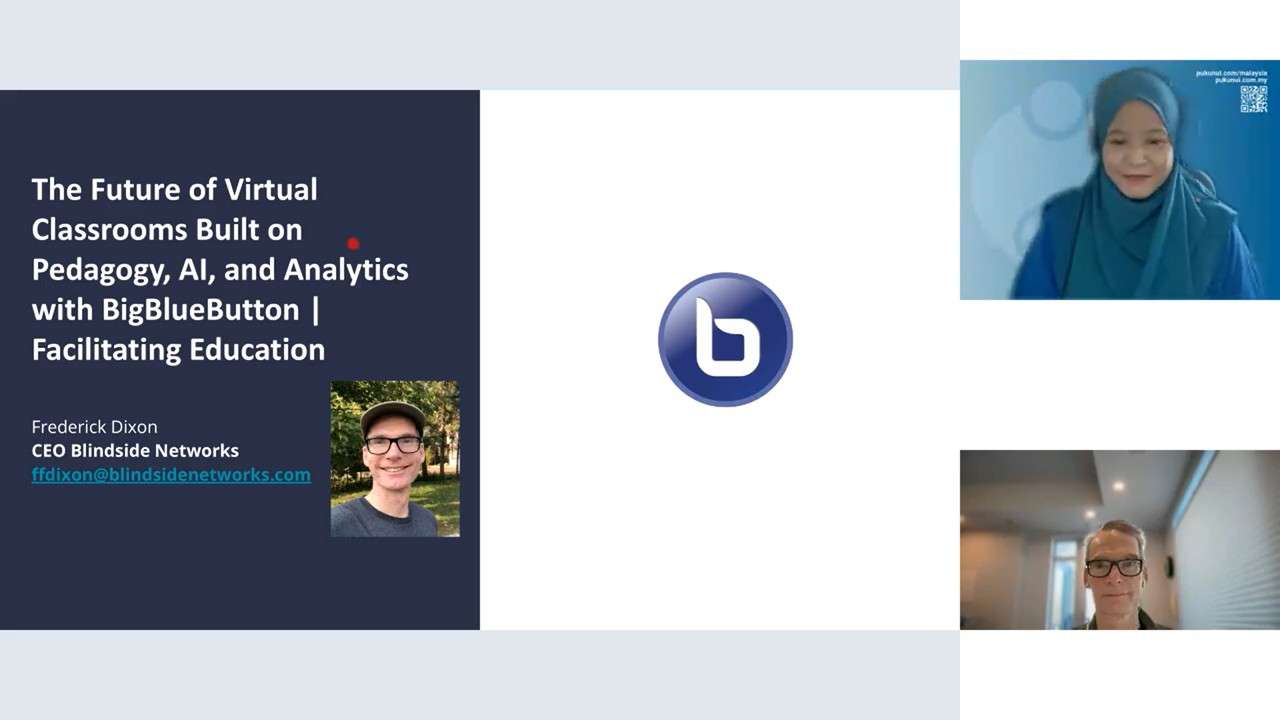
The Fourth #LearnWithPukunui Webinar Explores the Future of Virtual Classrooms with Fred Dixon
The future of education is not about replacing educators with artificial intelligence. It is about using technology to strengthen human connection and create more meaningful learning experiences.
In this webinar, Fred Dixon, CEO of Blindside Networks and Co-founder of BigBlueButton, explored how virtual classrooms can evolve beyond simple video conferencing tools to become spaces that support active learning, engagement and better teaching outcomes.
Rather than focusing on AI hype, Fred addressed a much more important question: how can technology help educators move students from passive observation to genuine participation?
Learning Should Come Before ‘Meetings’
One of the key points raised during the session was that virtual classrooms should be built for learning, not simply for ‘meetings’.
Many video conferencing platforms were originally designed for workplace communication and information delivery. While these tools may work well for business meetings, they often encourage passive learning behaviours in education settings, where students simply log in, listen and disengage.
Fred explained how this can lead to cognitive offloading, where students rely too heavily on technology to think for them instead of actively processing information themselves.
For effective virtual learning opportunities, students need to engage, respond, reflect, and participate throughout the lesson.
The “Oreo Cookie” Problem in AI Learning
Fred introduced an interesting analogy when discussing AI in education.
He compared over-reliance on AI tools to eating an ultra-processed Oreo cookie. It may feel enjoyable and convenient in the moment, but it provides little long-term value.
Similarly, when students use AI tools to complete assignments without engaging in critical thinking, they may complete tasks faster but retain very little knowledge.
Real learning happens when students enter what psychologists describe as System 2 thinking, which involves slower, more deliberate and effortful thought processes.
Fred compared this to feeling muscle strain during exercise. Just as physical discomfort often signals muscle growth, mental struggle and frustration can be signs that meaningful learning is taking place.
When learning feels too easy, there is a possibility that real learning is not happening at all.
How Technology Can Support Better Learning Experiences
While the session highlighted risks associated with overusing AI, it also demonstrated how technology can positively support teaching and learning when used intentionally.
Educators remain central to learning
Drawing on the Zone of Proximal Development, Fred explained that effective learning often happens when students are challenged just beyond their current ability.
This process requires educators to guide students, provide feedback and help them navigate difficult concepts.
Technology should support this process, not replace it.
Removing the “back of the classroom”
In physical classrooms, disengaged students often hide at the back of the room.
The same issue exists in virtual learning environments, where students may turn off their cameras and become passive participants.
Using features such as live analytics and Smart Slides in BigBlueButton, educators can monitor participation levels in real time and quickly identify students who may need additional support.
Visual assessment in real time
Fred also demonstrated how multi-user whiteboards can improve engagement.
Educators can view every student’s cursor activity simultaneously, while students only see their own responses. This allows instructors to quickly assess understanding across an entire class and address confusion immediately.
Using AI to save educators’ time
Rather than allowing AI to complete work on behalf of students, Fred encouraged educators to use AI as a productivity tool.
For example, AI can help generate quiz questions, create active recall activities and automate repetitive administrative tasks.
This gives educators more time to focus on what matters most: teaching, mentoring and providing personalised feedback.
Building a connected learning ecosystem
Looking ahead, Fred shared his vision for a more connected learning environment in which platforms such as Moodle and BigBlueButton work more seamlessly together.
This would allow educators to access important learner information such as assignment progress, attendance records and login activity during live sessions, enabling more informed teaching decisions.
Watch the Recording
Common Questions About AI and Virtual Classrooms
How does AI affect student learning?
AI can help students learn faster in the early stages, but overdependence may reduce long-term retention if students stop engaging in deep thinking.
What makes BigBlueButton different from Zoom or Teams?
Unlike Zoom or Microsoft Teams, BigBlueButton was designed specifically for education, with built-in teaching tools that support interaction and engagement.
What are Smart Slides?
Smart Slides automatically detect poll questions within presentation slides and allow educators to launch polls instantly without disrupting lesson flow.
How do live analytics improve online teaching?
Live analytics provide realtime insights that help educators identify disengaged learners in real time, making it easier to intervene early and keep students involved.
Can AI improve post-class retention?
Yes. AI can analyse lecture transcripts and help generate quizzes or revision exercises that reinforce learning after class.
Final Thoughts
The future of virtual classrooms is not about replacing teachers with machines.
It is about creating learning environments that prioritise participation, collaboration and human connection.
By using AI to reduce administrative workload and leveraging analytics to improve engagement, educators can implement virtual classroom strategies that result in more effective, more interactive, and ultimately more human-centred learning environments.

Pukunui would like to thank Fred Dixon for his time and for sharing valuable insights on the future of virtual classrooms, AI and learning analytics for education. We would also like to thank all participants for joining the session and contributing to the discussion.
As highlighted throughout the webinar, the future of virtual learning is not about replacing educators with technology, but rather understanding the role of technology in education. It is about creating more engaging, humancentered learning experiences in which AI and analytics support better teaching, stronger participation, and meaningful student outcomes.
Please join us again for our upcoming webinars. You can check our latest events here.
